
Have you ever wondered what the different traffic light colors really mean? Traffic lights are essential for road safety, helping to control the flow of traffic. But each color carries its own specific message that keeps everyone safe on the road.In this article, you will learn about the meanings behind each traffic light color. We will explore how these colors work together to ensure smooth traffic and safety for both drivers and pedestrians.
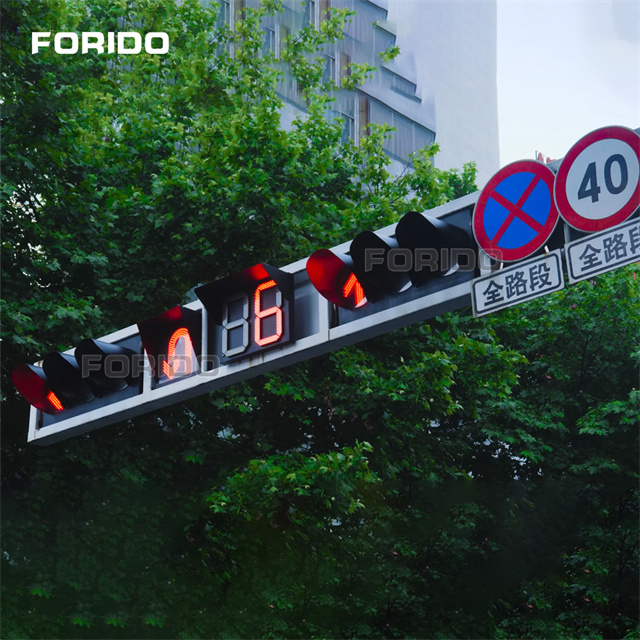
● Prevent Chaos: Without traffic lights, intersections would become chaotic, leading to accidents, traffic jams, and delays.
● Reduce Accidents: By providing clear, universally understood instructions, they help reduce the risk of accidents.
● Control Traffic: Traffic lights manage the flow of vehicles, pedestrians, and cyclists in a coordinated manner.
● Enhance Pedestrian Safety: They ensure pedestrian safety at crosswalks and facilitate smooth movement for emergency vehicles.
● Support Urban Planning: They contribute to better urban planning, helping reduce pollution and improve overall traffic efficiency.
The traffic light system follows a universal color code designed for clarity and uniformity. This consistency is essential for ensuring that drivers from different regions can understand and follow traffic signals without confusion.
● Red signals “stop.”
● Yellow (Amber) signals “prepare to stop.”
● Green signals “go.”
This color-coding system is adopted globally to provide consistency and reduce confusion among drivers. Though the colors remain the same worldwide, their interpretations can slightly vary depending on the local context, such as the use of flashing lights or additional signals like left-turn arrows.
Traffic light timing isn’t arbitrary; it’s carefully planned and adjusted to ensure optimal traffic flow. Traffic signals are typically set to a fixed timing schedule during off-peak hours, but during rush hour, these schedules can be modified to adapt to current traffic conditions.
Modern traffic lights often use adaptive signal control technology. This technology uses real-time data from sensors embedded in the road or cameras to adjust the timing of lights based on traffic flow. For instance, if a high volume of vehicles is detected at an intersection, the green light duration may be extended to allow more vehicles to pass.
Table: Basic Traffic Light Timing Schedule
Time of Day | Traffic Flow Adjustment | Light Timing |
Morning Rush Hour | Longer green for inbound traffic | 60 seconds green, 30 seconds red |
Midday (Off-Peak) | Balanced for all directions | 30 seconds green, 30 seconds red |
Evening Rush Hour | Longer green for outbound traffic | 90 seconds green, 30 seconds red |
This timing ensures that traffic is managed efficiently, reducing congestion and improving safety. Sensors and cameras are key to this adaptive system.
The red light is perhaps the most universally recognized and important color in traffic lights. Its meaning is simple and direct: stop. When the light turns red, all vehicles must halt, giving right of way to other traffic, pedestrians, or cyclists.
Red lights are critical in preventing accidents at intersections. Running a red light can result in serious accidents, especially in busy urban environments where other vehicles or pedestrians might be crossing at the same time. Most countries have strict laws about running red lights, with penalties ranging from fines to license suspension.
Table: Key Reasons to Stop at a Red Light
Reason | Importance |
Safety for pedestrians | Ensures pedestrians can cross safely without interference from vehicles. |
Cross traffic movement | Allows vehicles from the opposite direction to move through the intersection. |
Prevents accidents | Reduces the likelihood of collisions at busy intersections. |
Yellow, or amber, lights serve as a caution signal. When you see a yellow light, it’s a warning that the light is about to turn red. This gives drivers time to slow down and prepare to stop.However, many drivers mistakenly speed up when they see a yellow light, hoping to pass through before it turns red. This can be dangerous, especially in high-traffic areas. The best practice when approaching a yellow light is to evaluate your distance from the intersection and whether stopping is a safer option than rushing through.
Table: What to Do When Approaching a Yellow Light
Situation | Action |
Far from the intersection | Slow down and prepare to stop. |
Close to the intersection | Continue at a safe speed and pass through. |
At a stop line but not past it | Stop safely, do not attempt to rush through. |
Green lights mean go—vehicles can move forward. However, it’s essential to check for any pedestrians, cyclists, or vehicles that might be crossing your path. Green lights are not a guarantee that the intersection is clear, so it’s important to proceed cautiously.
In some cases, a green light might also indicate a green wave, which is when a series of green lights are timed to allow uninterrupted traffic flow along a corridor. This is often used in busy urban areas to minimize stops and improve traffic flow.
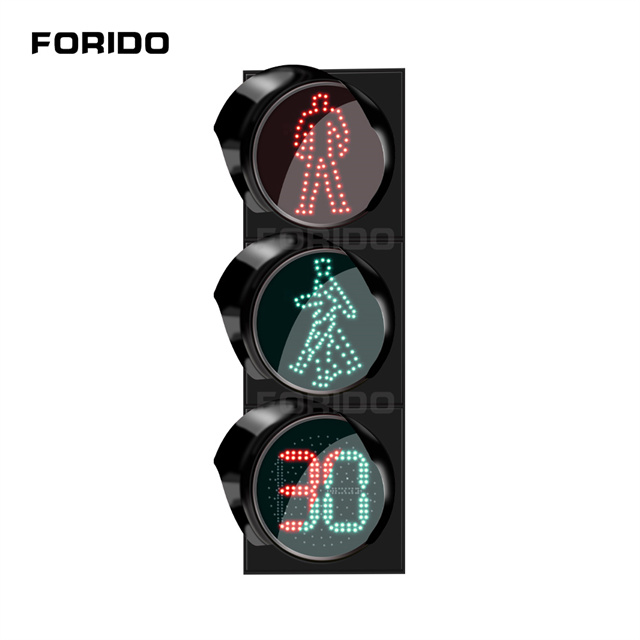
Pedestrian traffic lights work similarly to vehicle signals, using red and green colors to indicate when it’s safe to cross the street. In addition to color, pedestrian signals often feature symbols to make them more accessible to non-drivers.
● Red pedestrian signal: A red hand or "Don’t Walk" symbol indicates that pedestrians should not cross.
● Green pedestrian signal: A green walking person or "Walk" symbol indicates it is safe to cross.
These signals help pedestrians understand when they can move across the road safely, especially in high-traffic areas where vehicles may be turning or speeding through intersections.
Pedestrian signals must be carefully coordinated with vehicle signals to avoid accidents. For example, when a vehicle signal turns red, the pedestrian signal will usually turn green, allowing pedestrians to cross safely.
This synchronization ensures that both pedestrians and vehicles have a clear understanding of when they can move and when they must stop. In some cities, there are pedestrian countdown timers that show how many seconds remain before the light changes, helping people cross safely without rushing.
While the basic color code remains the same globally, there are some regional differences in how traffic lights are interpreted. In some countries, flashing red lights might mean to stop and proceed cautiously, while in others, it means an emergency vehicle is nearby.
In countries like the U.S. and Europe, traffic light color codes are strictly followed. However, in regions such as Asia and parts of Africa, the interpretation and additional signals might vary. Some countries also use flashing green lights during certain hours or at intersections with low traffic volume, a feature that’s less common in Western nations.
In many non-Western countries, there are additional traffic light rules. For example, in India, traffic lights may use a combination of flashing red and yellow lights to signify specific actions. These lights may signal that the intersection is temporarily open or closed for certain types of vehicles.Understanding local variations is essential for drivers who travel internationally. It’s always a good idea to learn the local traffic laws when visiting a new country to avoid confusion or accidents.
The history of traffic lights dates back to the early 20th century. The first known traffic light was installed in London in 1868. However, this system was gas-powered and manually operated. The first electric traffic light was developed in Detroit, USA, in 1920, paving the way for the modern traffic lights we use today.
Table: Timeline of Key Traffic Light Inventions
Year | Event |
1868 | First gas-powered traffic light installed in London. |
1920 | First electric traffic light installed in Detroit. |
1960s | Widespread adoption of electric traffic lights. |
1990s | Introduction of adaptive traffic control systems. |
With advancements in technology, traffic light systems have become smarter. The introduction of adaptive traffic control systems has made it possible to adjust the timing of lights based on real-time traffic data. Additionally, vehicle-to-infrastructure (V2I) communication allows vehicles to communicate directly with traffic lights, enabling smoother flow and reducing congestion.Smart traffic systems also integrate AI to analyze traffic patterns and predict future traffic conditions, optimizing signal timings for better traffic management.
Traffic lights can experience various malfunctions due to factors such as power outages, sensor failures, or communication breakdowns. A common issue is when the inductive loop sensors (embedded in the road to detect vehicles) stop working, leading to improper signal changes.
Malfunction | Effect on Traffic Flow |
Power outage | All signals may turn off, causing chaos. |
Sensor failure | Vehicles may not trigger green lights. |
Communication breakdown | Miscoordination between lights. |
Malfunctions in traffic light systems can create confusion, especially during rush hours. When lights fail to switch correctly, it can lead to traffic jams, accidents, or pedestrian confusion. In cases where signals stop working entirely, drivers may treat intersections as stop signs, which can lead to collisions.Malfunctioning signals require quick troubleshooting, such as backup power sources and maintenance checks.
Traffic lights are vital for road safety and efficient traffic flow, helping to prevent accidents and ensure smooth transportation. As cities evolve, traffic systems are becoming smarter, reducing congestion and improving safety. At Forido, we specialize in innovative outdoor lighting solutions that support safer, more efficient urban environments. Our focus on quality and sustainability helps create smarter cities and safer roads.
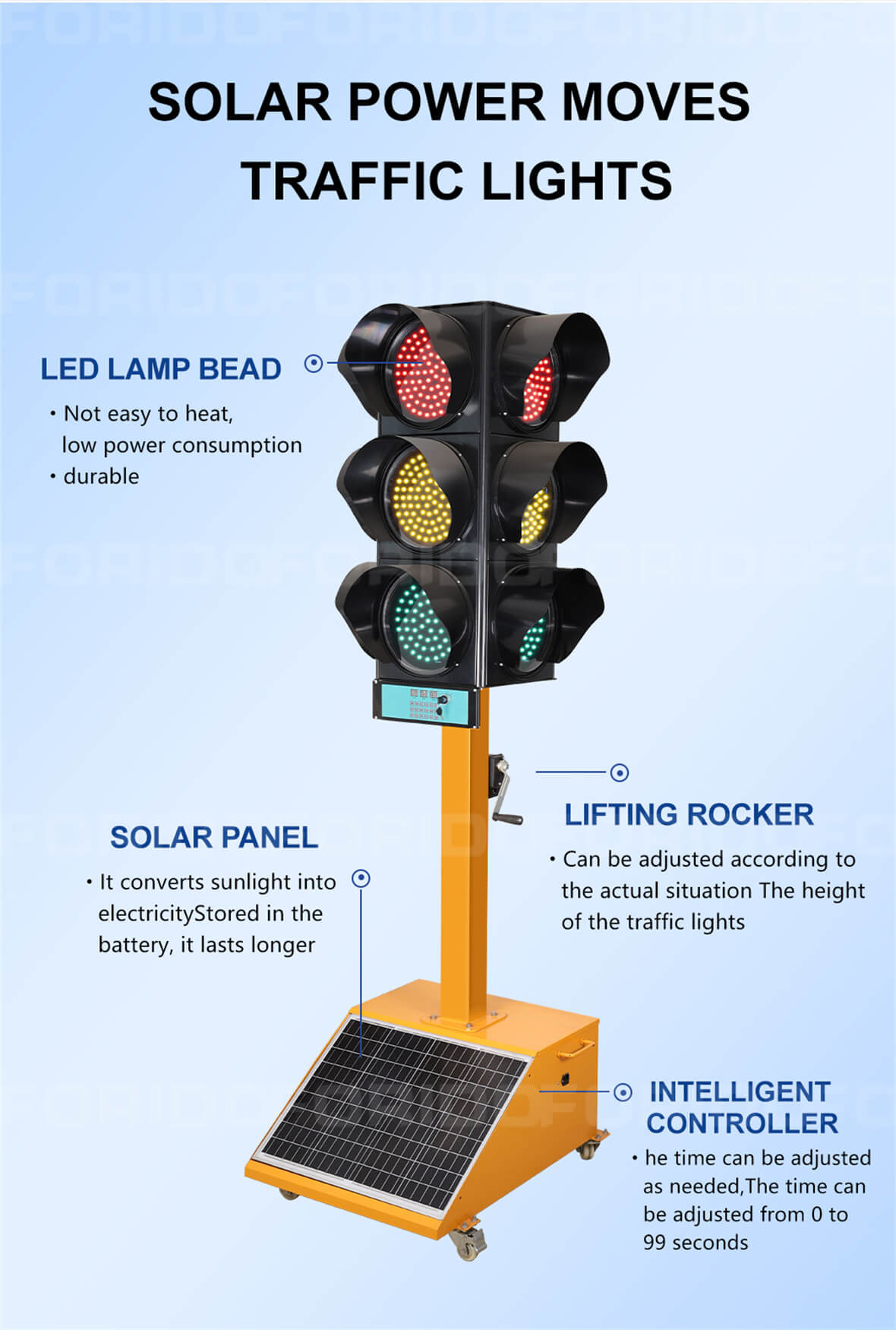
A: Traffic lights are used to control the flow of traffic. The red light means stop, the yellow light signals prepare to stop, and the green light means go. These colors help maintain safety and reduce accidents by providing clear instructions for drivers and pedestrians.
A: Following traffic light signals ensures safety for both drivers and pedestrians. Traffic lights help organize roadways, reducing the risk of accidents, managing traffic flow, and improving overall road safety by providing coordinated instructions.
A: Traffic lights are crucial in urban planning as they manage traffic efficiently, minimize congestion, and allow smooth movement of vehicles and pedestrians. Properly timed signals help reduce pollution and support sustainable city development.
A: While the colors of traffic lights are generally universal, some countries may have unique rules or variations in their interpretation. For example, flashing yellow or green lights might have different meanings depending on the local traffic laws.
